

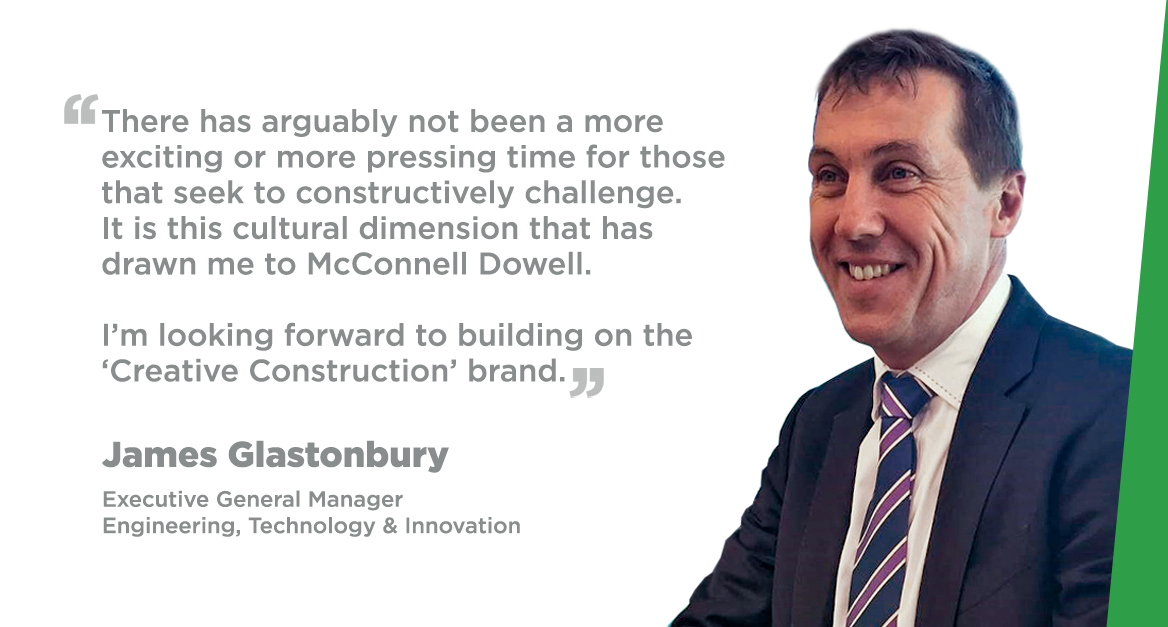
The McConnell Dowell Group is pleased to announce the appointment of Dr James Glastonbury as Executive General Manager Engineering, Technology and Innovation.
James has an outstanding reputation in Australia and internationally as a civil engineering thought leader and has played a pivotal role in driving engineering excellence, including in the digital and BIM space.
In announcing this key leadership appointment to the Group’s Executive Committee, CEO Scott Cummins said…
“We are very excited that James has elected to join the McConnell Dowell Group to help drive our journey in these areas, and to oversee the continued establishment of communities of practice and centres of excellence across our core disciplines.”
James is looking forward to leading the team at McConnell Dowell as the business solidifies its position as the ‘Creative Construction’ company...
“There has arguably not been a more exciting or more pressing time for those that seek to constructively challenge. It is this cultural dimension that has drawn me to McConnell Dowell. I’m looking forward to building on the ‘Creative Construction’ brand.”
James will be based in Sydney and will commence in the role in the coming months.
The St Marys Bay Area Water Quality Improvement project secured another win with the completion of the last tunnelling drive at the end of 2020. Hinehōaka, the project’s Tunnel Boring Machine (TBM), successfully completed over one kilometre of micro-tunnelling in less than six months. The 1,120- metre storage pipeline, which includes a marine outfall, was constructed in three separate tunnelling drives using pipe-jacking methods.
Two shafts were constructed in Council parkland at the bottom of the cliff face to accommodate each tunnelling drive and a third shaft needed to be constructed in the narrow streets around St Marys Bay. This shaft was carefully and cleverly designed to be able to retrieve the TBM from a 3.8-metre diameter shaft, 25 metres below ground.
Each tunnelling drive had its own unique challenges but one of the major challenges the project team faced was tunnelling very close to, and underneath, restored villas worth millions of dollars in one of Auckland’s oldest suburbs. To mitigate stakeholder issues and concerns, the project set up a ‘SiteHive’ unit to collect data while the TBM was operating.
The unit continuously collected noise, dust and vibration monitoring readings from the worksite and this data helped proactively manage consent compliance, as well as record the impact of the operations. When noise reached predetermined levels a photo and sound recording were taken to capture the activity onsite. This constant monitoring meant the team could ensure construction activity operated within the consent conditions and any exceedances were investigated to see what could be done differently to ensure compliance in the immediate future.
Health and wellbeing has also been a huge focus on this project, as all three tunnelling drives were carried out by the team working in shifts over a 24-hour, five days per week work period. To educate the team around mental health, McConnell Dowell invited Mates in Construction, a programme aimed at improving mental wellness and reducing suicide in the construction industry, to run sessions onsite with the crew. We are proud to say that the St Marys Bay Area Water Quality Improvement project is the first McConnell Dowell site and fourth site in New Zealand to be Mates in Construction accredited.
The new pipeline will reduce wastewater overflows to St Marys Bay and Masefield Beach by 95 per cent. The high flows after rain events will be stored in the new larger capacity pipeline and pumped back into the sewer network for treatment when there is capacity. As well as reducing overflows, once complete the new marine outfall will discharge to an outfall far away from places where people swim.
The project is due to be completed during 2021.
This new brand sees the traditional Built Environs red replaced with a vibrant green
As the building business of the McConnell Dowell Group, the new branding more clearly aligns Built Environs with its parent organisation and reinforces the strength and support provided by the broader Group.
Over the past twelve months Built Environs has appointed new experienced leaders and reshaped the organisation as it has expanded into new markets to drive business growth in 2021 and beyond.
Built Environs Managing Director, Michael Clemenger said “Built Environs has a strong history of delivering significant and diverse projects and our new brand marks the next important phase of our expansion and growth. We’ll continue to work with our customers to create better buildings that enhance the way people live, work and play.”
The new brand will be rolled out across Built Environs’ sites and offices over the coming weeks.
The Regency Road to Pym Street (R2P) Project, jointly funded by the Australian and South Australian governments, is creating 210 jobs per year during construction.
The R2P Alliance is made up of the South Australian Government, and McConnell Dowell Constructors (Aust) Pty Ltd, Mott MacDonald Australia Pty Ltd and Arup Group Pty Ltd.
From mid-September 2019, girder segments were delivered to the Polonia Reserve compound, enabling ‘off-site’ assembly of the northbound and southbound centre spans. The girders were fabricated locally at Bowhill Engineering.
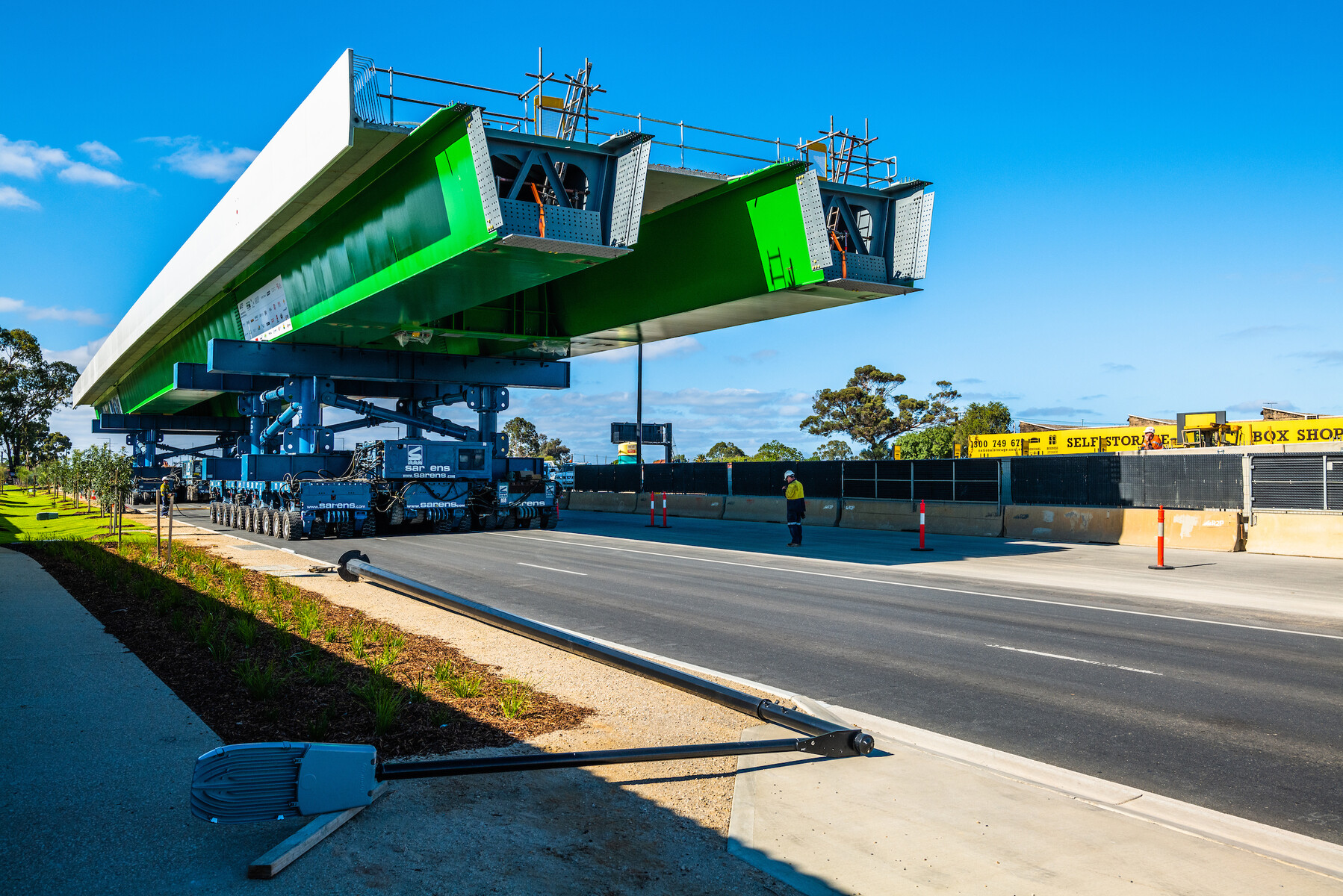
Once assembled, the two centre spans each measured 84 metres in length each and weighed 2600 tonnes in total.
On and off ramps and structures that support the spans, are being constructed at the South Road and Regency Road intersection.
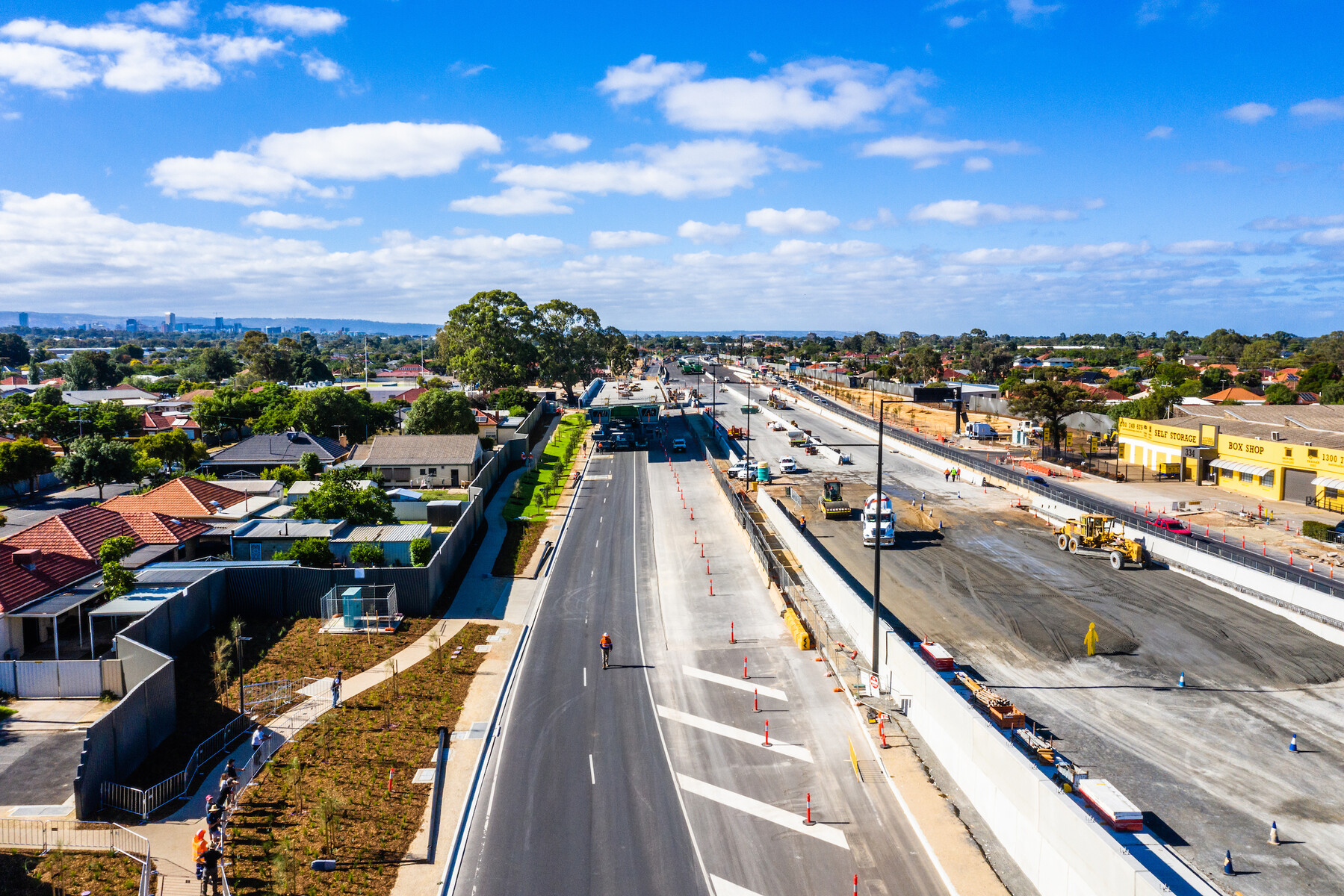
During 4 – 11 January 2021, the centre spans were transported from the Polonia Reserve compound to their final location, over Regency Road, using Self Propelled Modular Transporters (SPMTs). The major works required a partial closure of the South Road and Regency Road intersection for one week.
The centre spans travelled along the southbound carriageway of South Road and were lowered onto newly constructed concrete piers.
After the centre spans were installed, the eight back spans and 36 transfloor slabs were craned into place.
While all the attention was on the centre spans and back spans, a number of other milestones were achieved during the week including installation of:
- 21 cubic metres of concrete for the stich pour (concrete pour to fill gaps);
- Over 4000 bolts;
- Approximately 8 kilometres of power cables;
- Four traffic poles;
- Three Variable Message Signs; and
- Four road gantries.
These major works finished ahead of schedule, enabling the R2P Project to reopen the roads eight hours earlier than planned.
With these works complete, works will continue for several months at the intersection to complete the overpass. Final works prior to the opening of the overpass in mid-2021, include laying the final layer of asphalt, installation of concrete barriers to separate northbound and southbound traffic and line marking.
The Regency Road to Pym Street Project involves the construction of a new 1.8km section of non-stop motorway along South Road, connecting to the South Road Superway to the north and Torrens Road to River Torrens Project to the south.
The Regency Road to Pym Street Project will deliver travel time savings of up to eight minutes during peak periods and 4.5 minutes on average for around 53,000 motorists daily on this section of South Road.
The Regency Road overpass provides three lanes in each direction and two lanes in each direction (at-grade) on the surface roads underneath, for access to the surrounding community and local businesses.
Transportation of the second centre span for the Regency Road overpass
McConnell Dowell is pleased to announce the award of a contract by Port Authority of New South Wales for improvements to the Overseas Passenger Terminal, located in the iconic Circular Quay area of Sydney Harbour.
Built in 1960, the OPT is located in one of Australia’s busiest waterways. Over time, natural processes and vessel activity have caused scouring, accretion and movement of materials on the seabed around the terminal’s wharf. Port Authority’s Berthing Infrastructure Project will see improvement works to protect and support the wharf alongside the OPT to ensure it continues providing a safe berth for ships.
McConnell Dowell’s scope of works includes underwater sheetpile wall installation and caisson repairs to prevent ongoing movement of sediment around the wharf; clearing accumulated seabed material from the terminal’s berthing area; and scour protection design and installation to protect the seawall from future erosion.
McConnell Dowell’s leadership in marine design and construction, coupled with the company’s proven environmental management credentials, were crucial in securing this project.
The award of the project follows the recent release of McConnell Dowell’s first Reconciliation Action Plan and the company is pleased to be supported on the project by MGM Building Maintenance Pty Ltd (MGM), a proud indigenous business led by Anthony Mundine and Gosh Daher.
McConnell Dowell and MGM will use the project to showcase Australia’s first Indigenous Construction Hoarding, which will be adorned with the indigenous artwork of both companies.
The highly visible and colourful hoarding will clearly delineate the works from public spaces, while also promoting our indigenous culture and providing opportunities for indigenous youth, who will be employed by MGM to install it.