Capability Statement
Prepared for Prepared for Besix
May 2026
Introduction General
Thank you for the opportunity to present this brief capability statement which details a cross-section of our skills and experience, and showcases a selection of our recent projects.
About Us (typically use first)
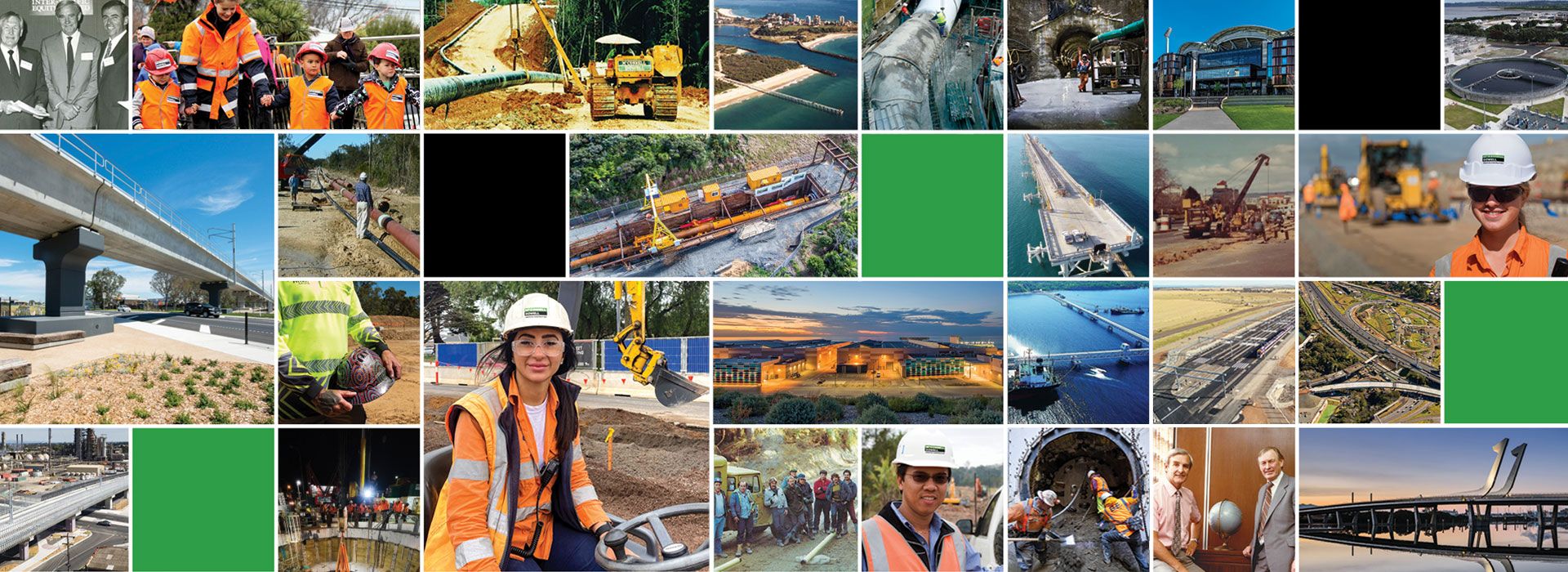
For over 65 years customers have been coming to McConnell Dowell with complex projects that require innovative solutions. That's why we're known as the Creative Construction company.
From remote resources and energy projects to city-shaping infrastructure, we've built thousands of quality assets and facilities.
Engineering-led, our expertise has grown steadily to span building, civil, electrical, fabrication, marine, mechanical, pipelines, rail, tunnel and underground construction..
Ports & Coastal Solutions
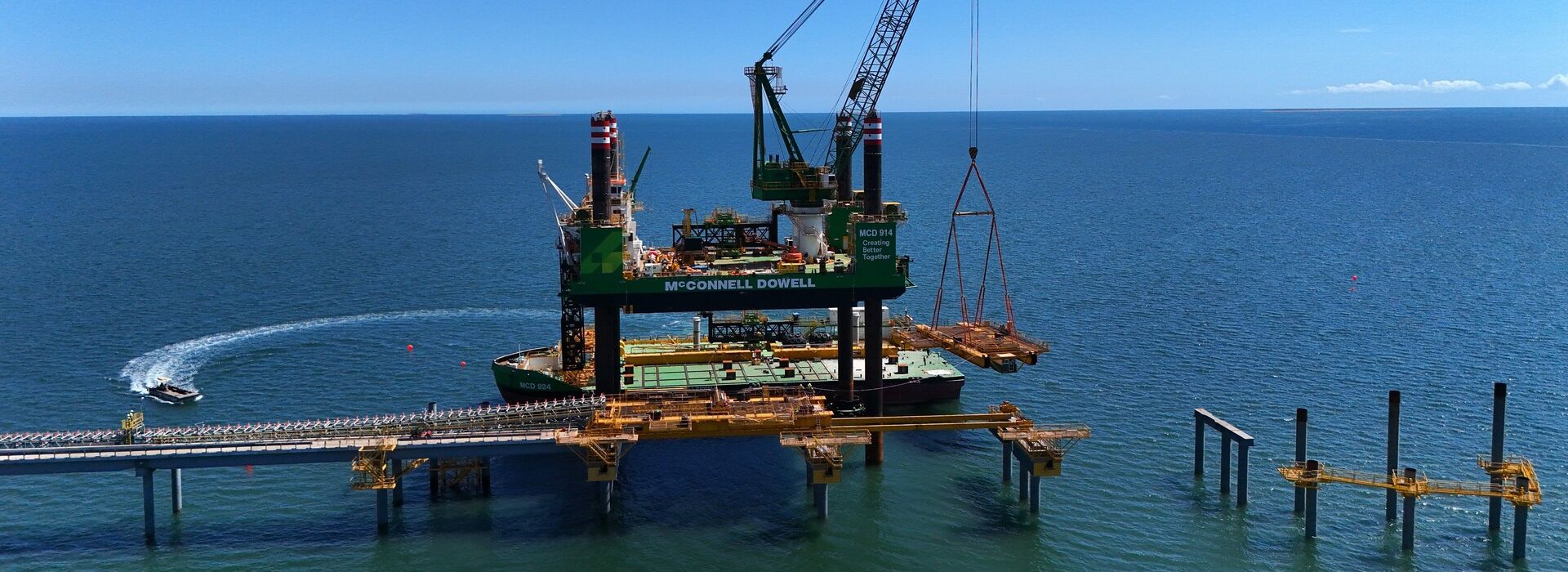
With over 330 marine projects completed across six decades, McConnell Dowell is synonymous with marine infrastructure.
From wharves and jetties to ocean outfalls, breakwaters, and submarine pipelines — we bring coastal confidence to every project.
Our modular approach to construction has helped create productive ports for clients like Rio Tinto, FMG, Vale, and BHP, where over 1.2 billion tonnes of iron ore are shipped annually from wharves we built.
Port Capacity Project - Webb Dock
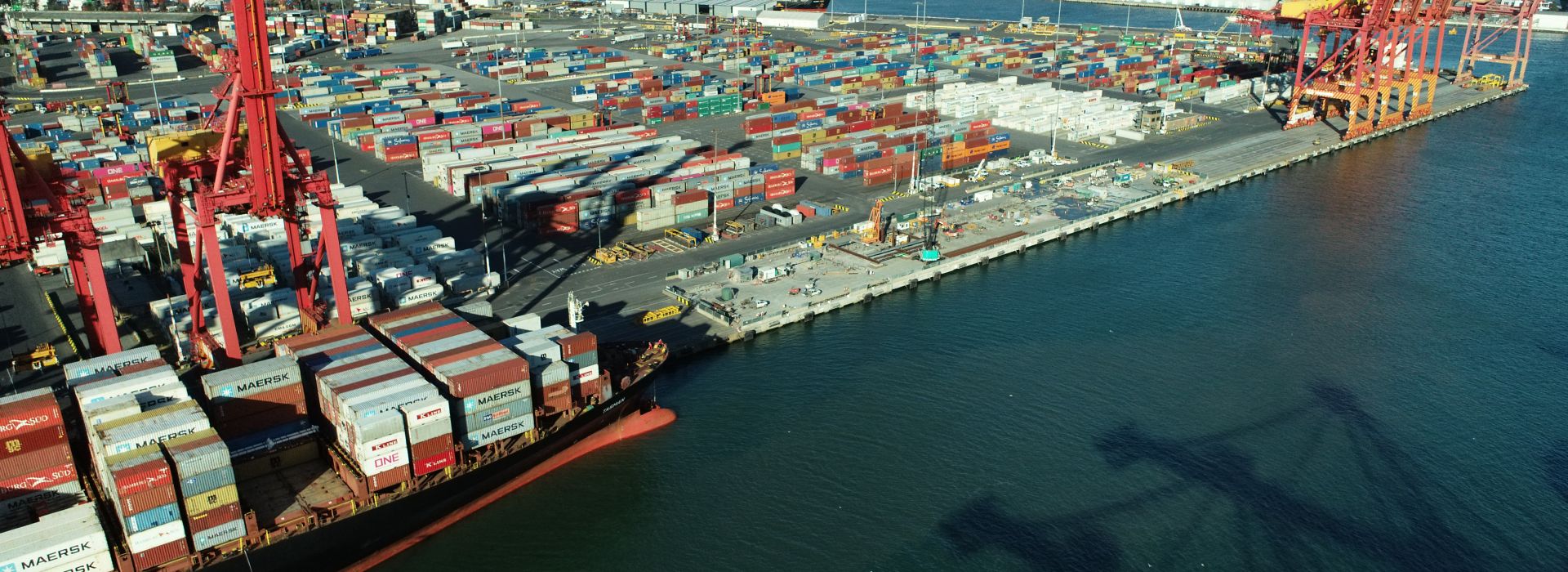
Enhancing and expanding Australia's busiest container port
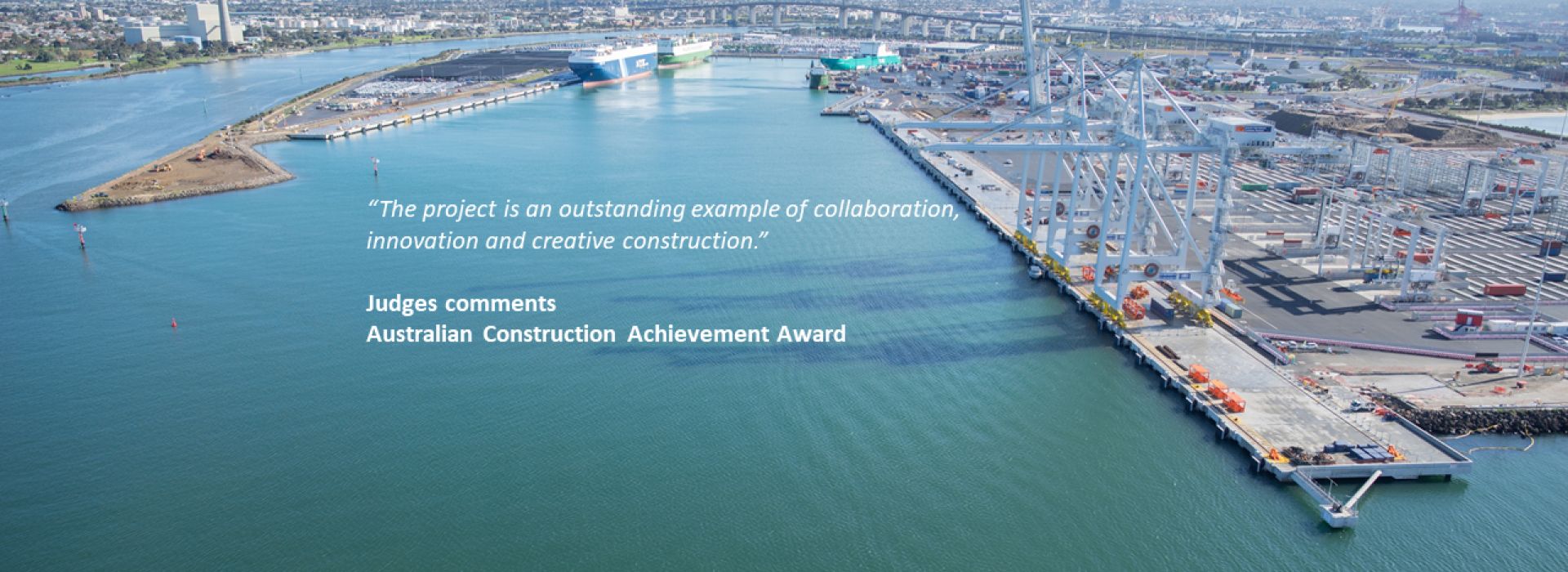
We received the Australian construction industry's highest accolade for this major wharf redevelopment within Melbourne's main port precinct.
This was a large and complex marine project delivered within Australia's busiest operational container port, and within very tight environmental controls to protect the rich marine life within the surrounding bay.
Fast Facts
- 900 tubular steel piles up to 1500 mm diameter and 45 m long driven as single length piles.
- 40,000 m³ of structural concrete.
- 10,000 tonnes of reinforcing steel.
- 40,000 m of sheet pile installation.
- 210,000 tonnes of imported quarry product.
- 15,000 m³ of rehabilitated concrete deck.
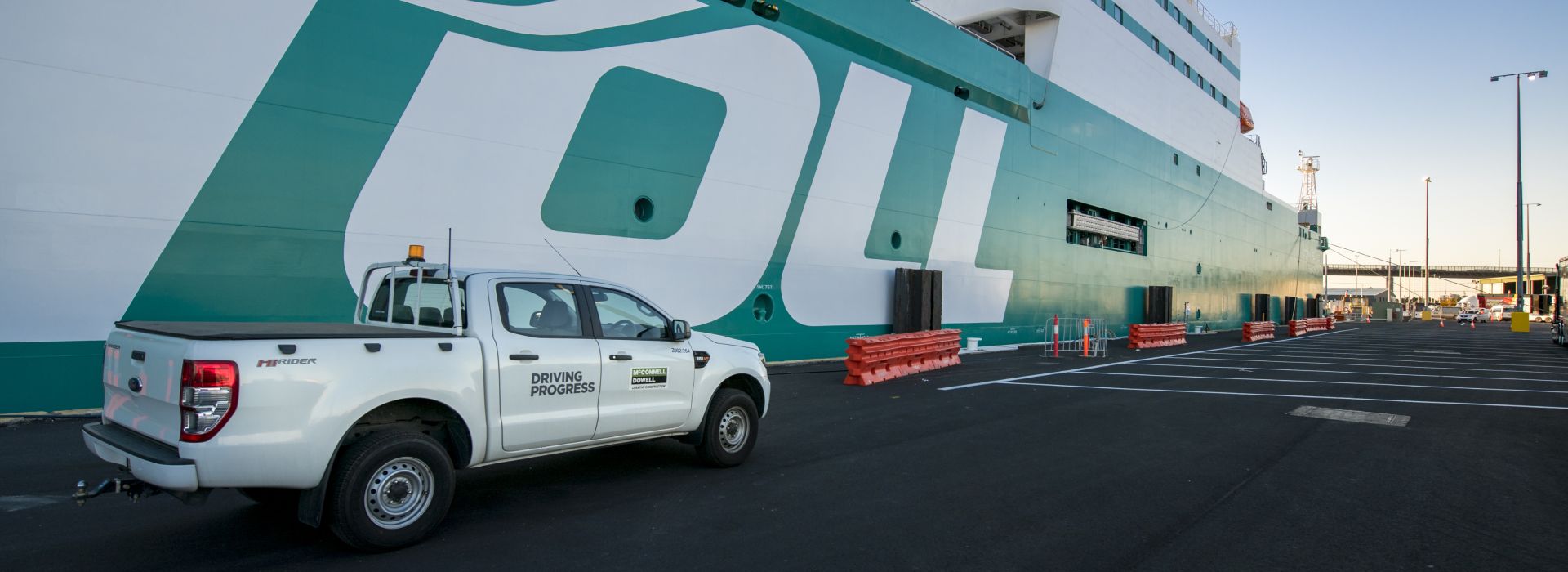
Toll Berthing & Infrastructure Project
Enhanced berthing facilities for efficient port operations at Webb Dock Melbourne
Drawing on our unmatched experience in the Port of Melbourne, we were engaged by Toll Transport to upgrade their wharfs and berthing infrastructure at Webb Dock, Melbourne and McGaw Wharf, Burnie. These terminals service Toll's trans-Bass Strait shipping route.
Upgrades were required at both facilities in advance of Toll receiving two new larger vessels which were longer, wider, deeper and heavier, resulting in the need for significant modifications to the existing infrastructure.
Fast Facts
- 10 week Early Contractor Involvement process
- Two operational wharves upgraded
- 200 concrete piles
- 200 metres of sheetpile wall
- Zero Lost Time Injuries
Common User Facility (Techport)
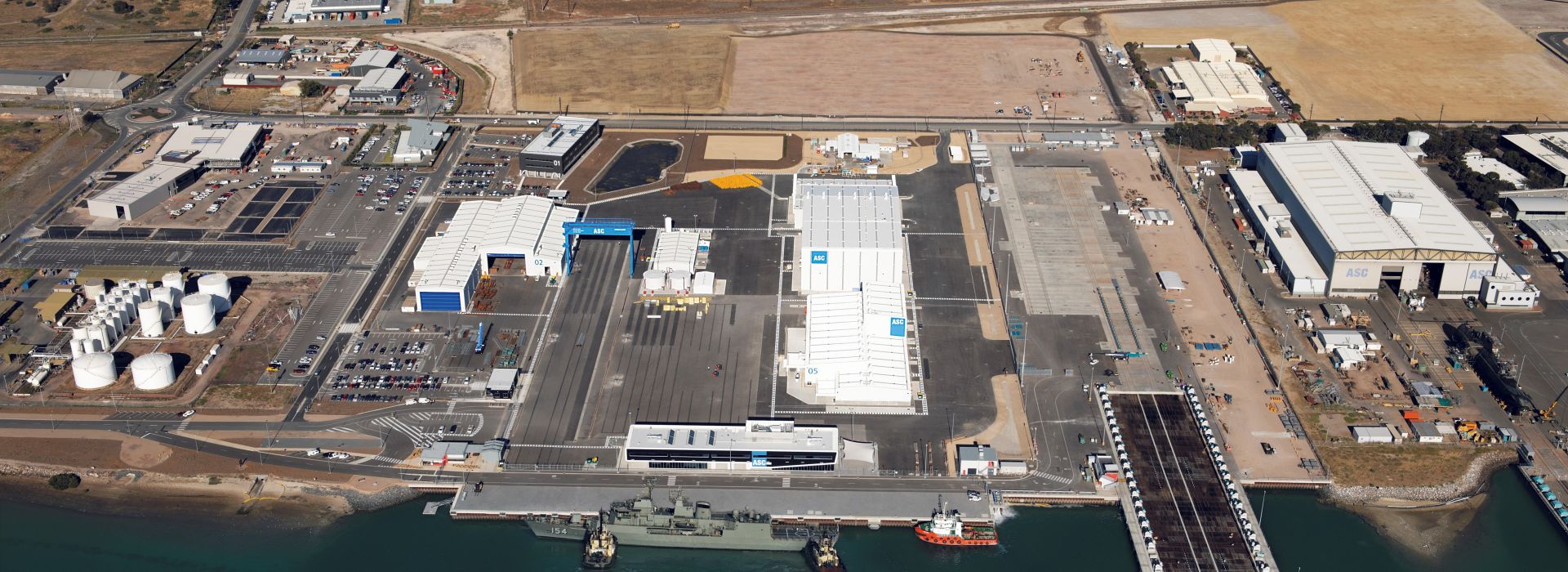
In one of the first Early Contractor Involvement (ECI) contracts in Australia, we designed and delivered the Techport Australia Common User Facility - a new state-of-the-art shipbuilding and maintenance complex on the Port River at Osborne, South Australia. We delivered it in joint venture with our building company, Built Environs (the MDBE JV).
The project was rolled out in two stages. In the first stage, our team worked in collaboration with design and technology partners and DefenceSA to develop the final design and risk adjusted price.
Fast Facts
- 213 m long, 25 m wide wharf
- 450,000 m3 material dredged
- 34 m x 160 m new shiplift pocket
- Installation of Australia's largest shiplift
- Works conducted in a sensitive marine environment and dolphin sanctuary
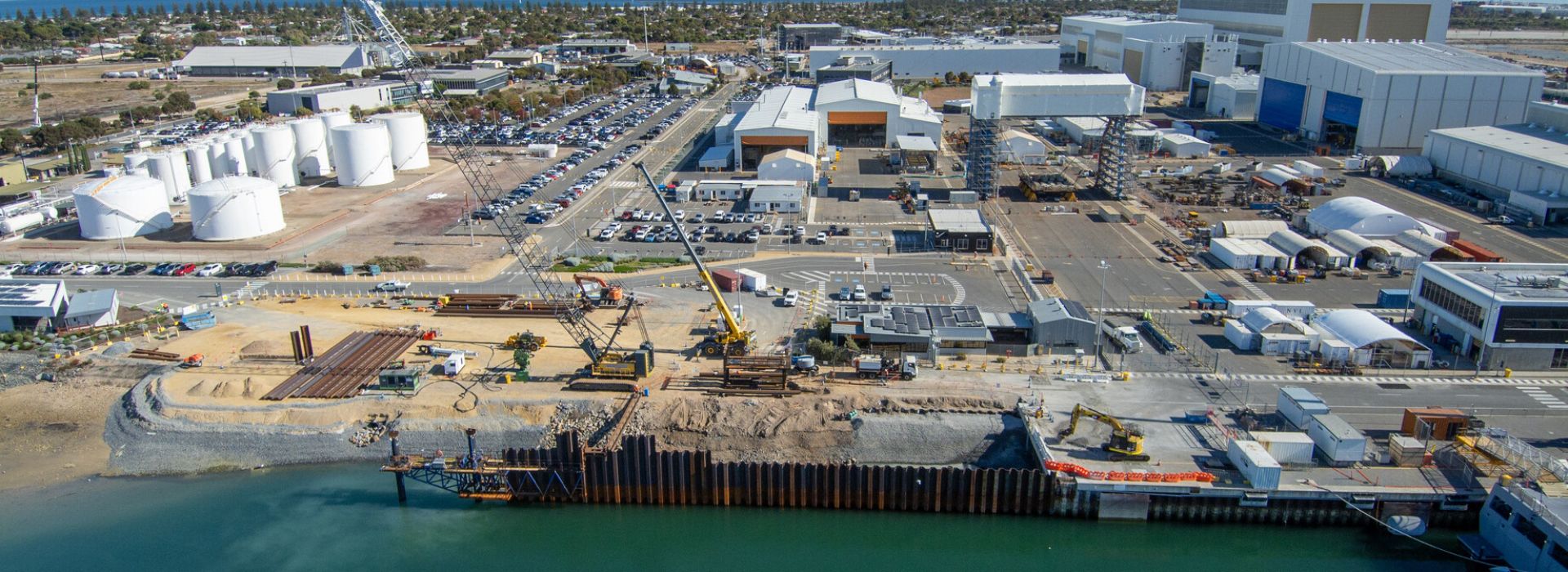
CUF Marine Development Works
Supporting Australia's shipbuilding capacity
Fast Facts
- Construction of 80 - 100 m land backed wharf
- 40,000 m3 of dredging
- Berth kiosk services, including water and eletrical supplies
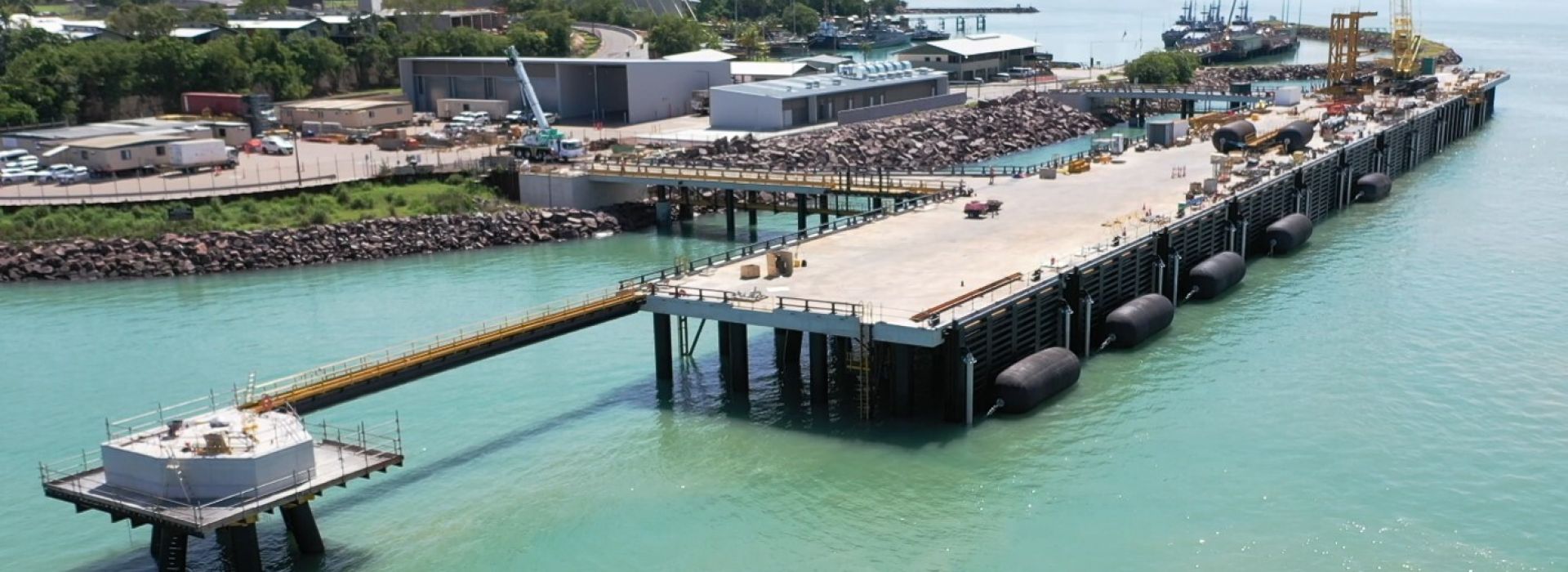
HMAS Coonawarra
New wharf and approach jetties to support the Australian Defence Force
We refined the initial concept design and constructed a new outer wharf structure at HMAS Coonawarra in Darwin to support the Australian Defence Force (ADF). The project involved the construction of a new 250 m long wharf and two approach jetties.
While the final structures are simple in their geometry and configuration, the site location and operational requirements were challenging.
Fast Facts
- 250 m long wharf
- Two approach jetties
- Enhancing ADF's maritime defence capability
Swanson Dock East Berths 1 & 2 Rehabilitation
Collaborative Approach, Safety Focus, and Minimising Disruptions in Port Rehabilitation Project
Working in collaboration with the Port of Melbourne, we successfully completed four contracts at Swanson Dock between 2017 and 2020.
After completing the award winning Port Capacity Project, we continued our partnership with Port of Melbourne with a series of smaller contracts to rehabilitate the iconic Swanson Dock - the heart of Australia's busiest container terminal.
Fast Facts
- Multiple projects successfully completed without disrupting port operations
- 412 piles driven
- 570 tonnes of reinforcement used
- 3,600 m2 of new wharf deck laid
Chith Export Facility
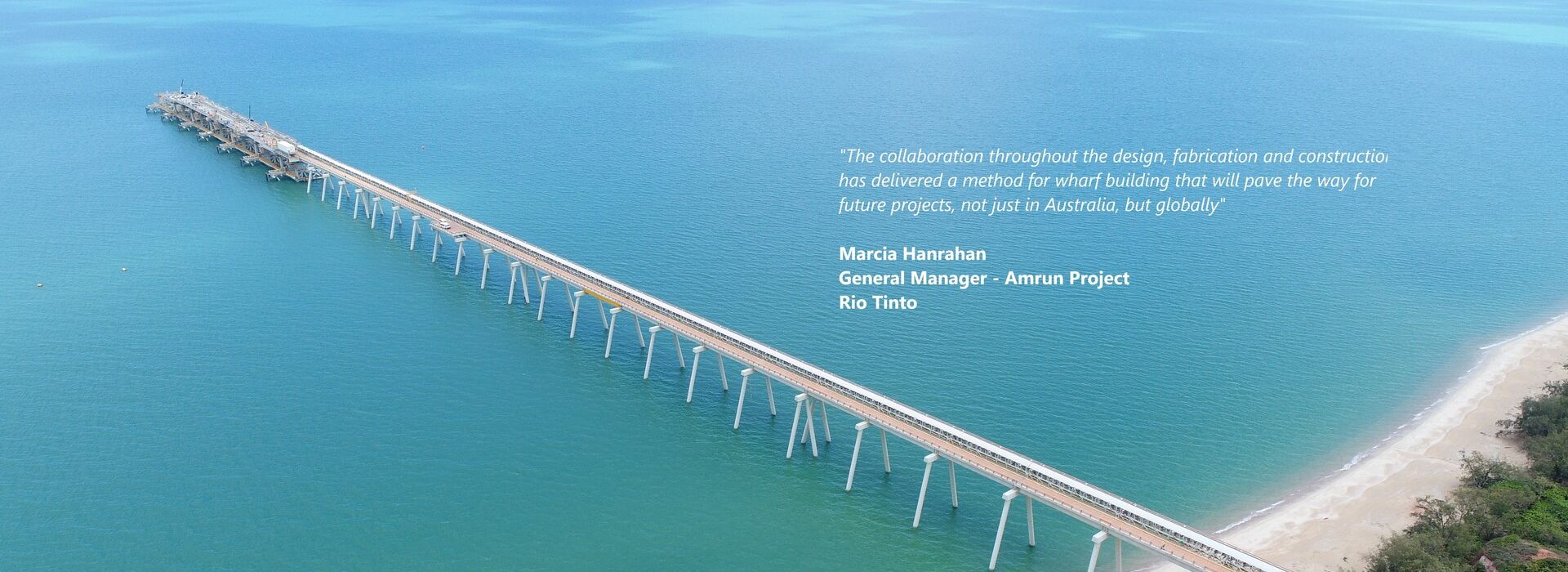
We revolutionised the design and construction of large-scale marine infrastructure when we delivered the Chith Export Facility - a large, complex and remotely located project for Rio Tinto at their Amrun bauxite mine, south of Weipa in Far North Queensland.
The facility comprises a 650 m access jetty, a 350 m loading wharf and an onshore conveyor system. Innovatively designed by Jacobs and constructed by us in just 10 months, modularisation was at the heart of the solution and our project team took it to new levels in scale and breadth.
Fast Facts
- 650 m access jetty
- 350 m long loading wharf
- Fully modularised construction approach
- 300,000 job-hours saved
- Build time reduced by 12 months to just 10 months
- Capital expenditure reduced by $40M
Mardie Salt & Potash Marine Structures
Delivering new marine facilities to grow Australian exports
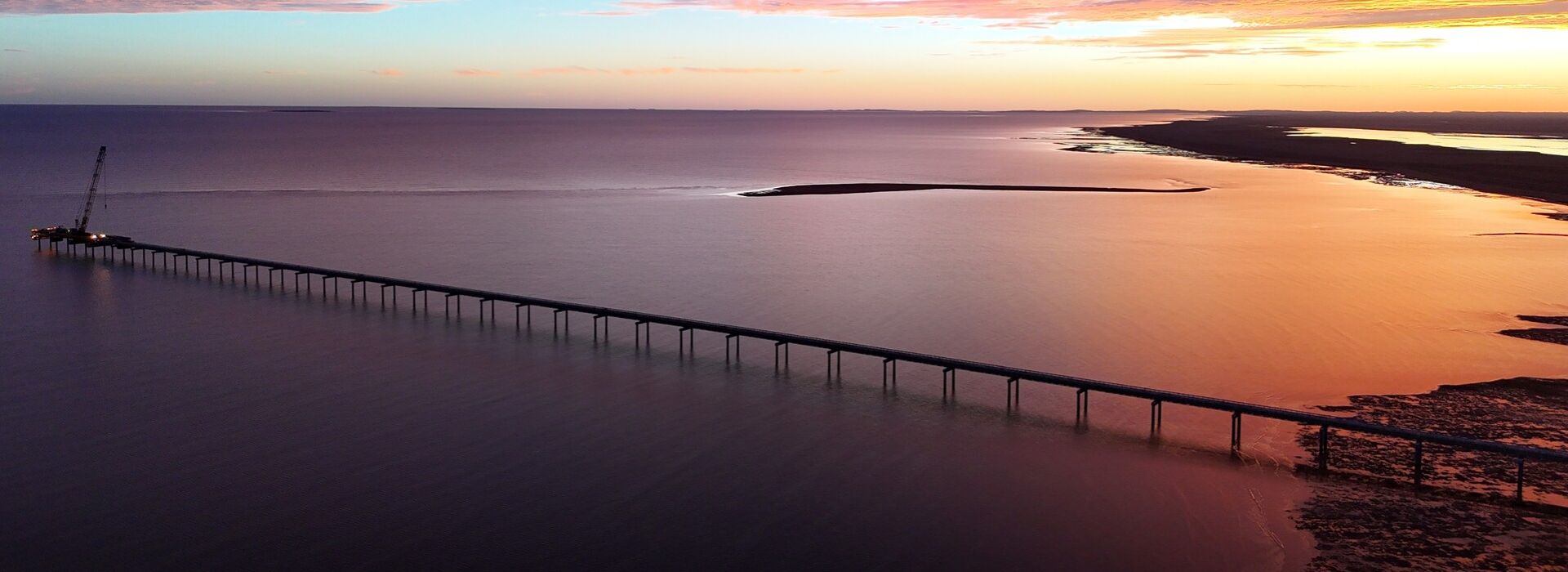
We designed and constructed the marine structures for BCI Minerals’ Mardie Salt & Potash Project in Western Australia, using our innovative canti-traveller system for speed and low impact delivery.
The 'Mardie' Project is a large-scale, solar evaporation operation on the Pilbara coast. Capacity of the completed facility is estimated to be 5.35 million tonnes per annum of high purity salt and 140,000 tonnes per annum of sulphate of potash, over an operating life of at least 60 years.
Fast Facts
- 2.4 km long jetty with berthing and mooring dolphins
- 200 steel piles, up to 30 metres long
- 100 m of jetty completed every 10 days using innovative canti-traveller system
Batangas LNG Terminal
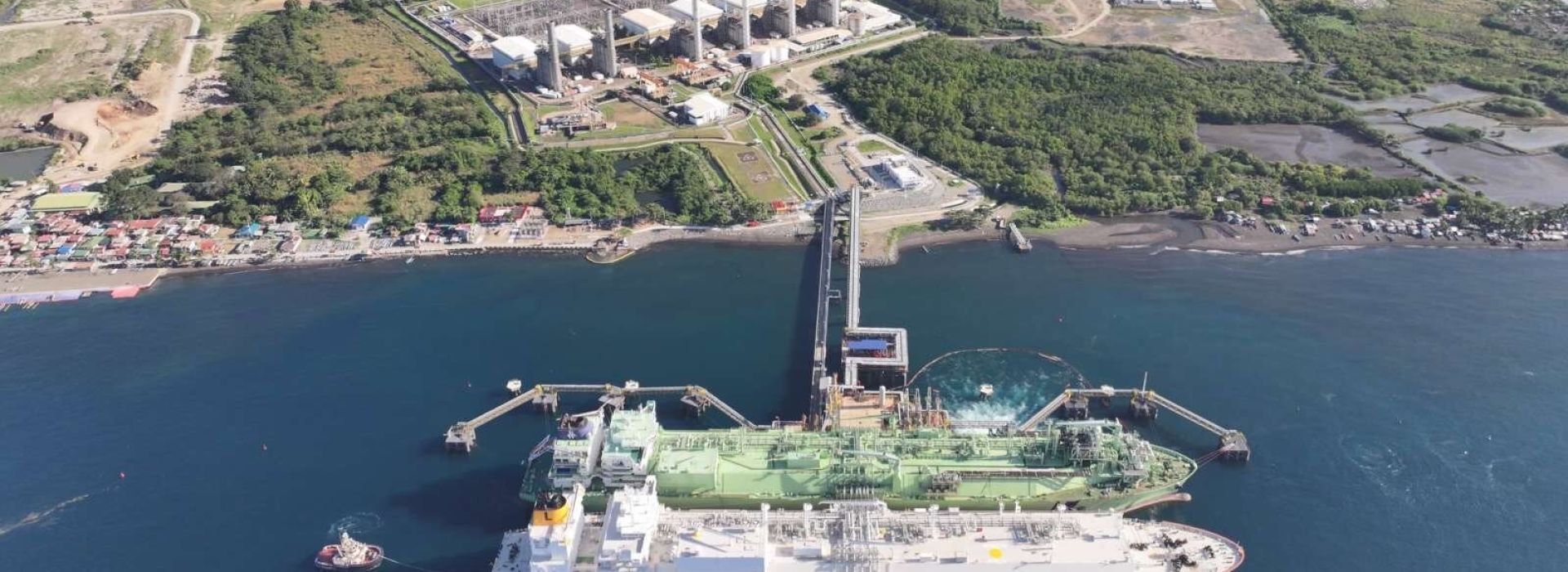
FGEN LNG Corporation (FGEN) engaged us to build and deliver the Interim Offshore Terminal Project ("IOT Project") at their LNG terminal in Batangas, in the Philippines.
We undertook the engineering, procurement and construction of both the Multi-Purpose Jetty and Onshore Gas Receiving Facility. The new Multiple Purpose Jetty is a permanent modification of the existing liquid fuel jetty which we constructed in 1998.
Fast Facts
- New multi-purpose jetty with topside infrastructure
- Onshore facilities, including control room
- 24 inch, 1.3 km long high pressure gas pipeline
- Extensive earthworks, including tsunami bund wall and access road
Digital Engineering & Technology
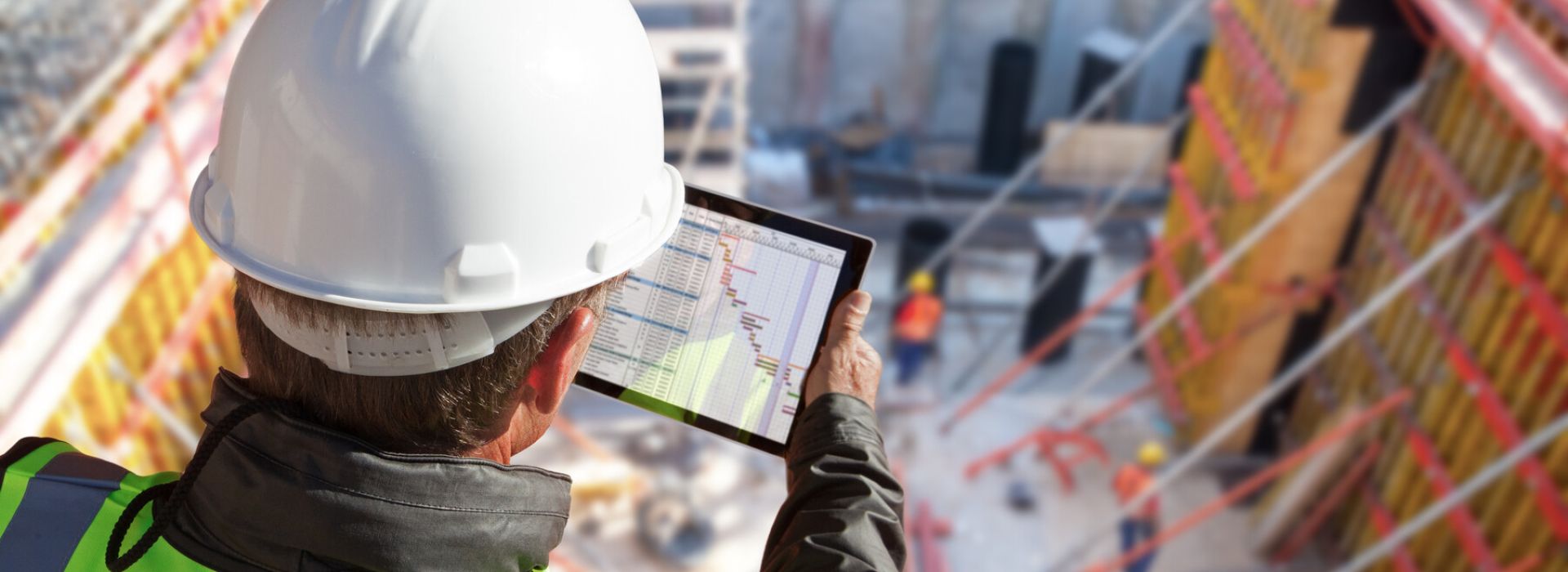
We take a ‘Digital First’ approach to all our projects, equipping our teams with the latest digital tools and systems from the design stage forward.
This helps them identify and address potential issues at the earliest stages of project development, effectively eliminating issues at their genesis leading to lower costs and delays once we start on site.
On site, we use digital tools like drones for surveying, and GPS tracked plant to monitor and improve safety and efficiency.
Bringing gaming technology to marine construction
Our digital engineering team are experts at building applications using 'Unreal Engine' - one of the world's most advanced 3D graphics game engines.
We've used Unreal to develop a traffic simulation tool to test temporary traffic management schemes before rollout, and simulated construction works in an operational airport with AI driven crowd behaviours.
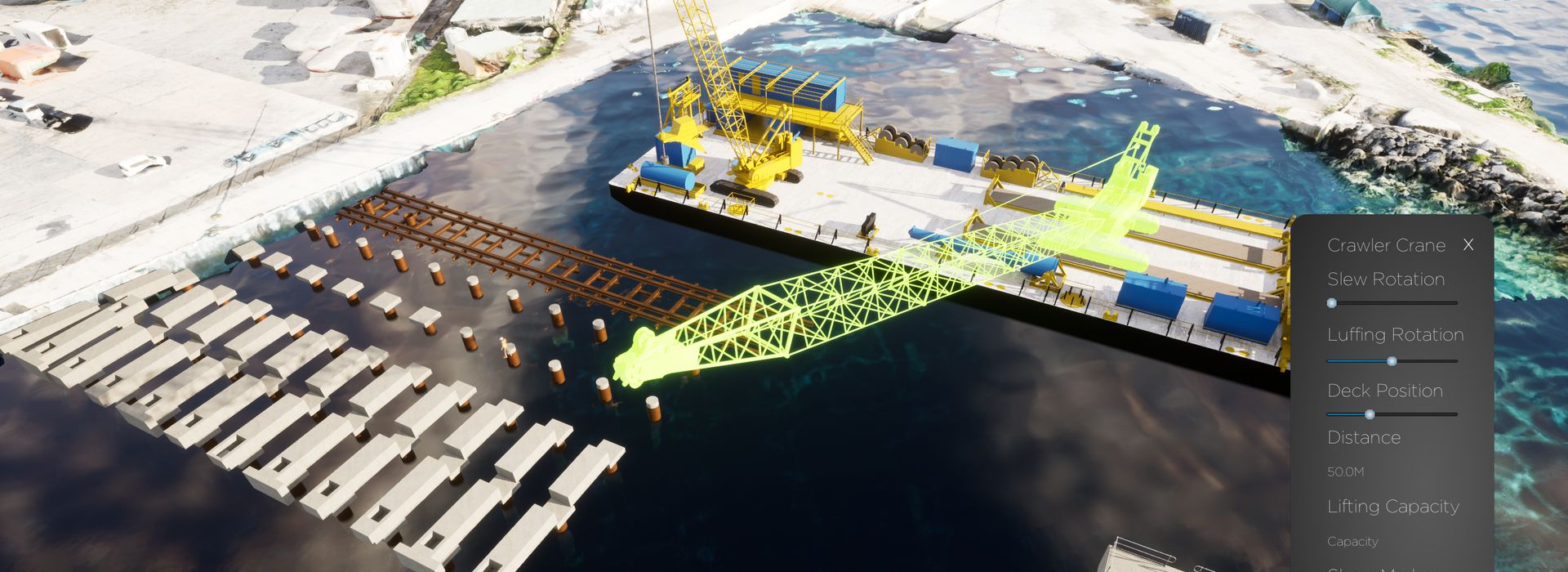
The team's most recent application is a powerful marine construction simulator - fully developed in-house. The simulator combines intelligent 3D plant models and reality capture data to accurately place marine plant in a virtual environment and replicate its real-world capabilities.
The tool enables our teams to simulate methodologies and iterate the positioning of plant and equipment around the design models. This is all done in a realistic environment with features such as accurate bathymetric data, reality capture point-cloud models, and real-world tide levels.
The permanent works build sequence can be tested to ensure we avoid clashes during construction. Plant and equipment is programmed with its real-world performance and dynamic constraints to enable equipment limitations to be established and enabling features such as crane hook capacity to be determined in real-time.
We are leading the industry in simulation - identifying and mitigating constructability issues during the design phase, driving program and cost certainty for our customers.

Temporary works design and coordination
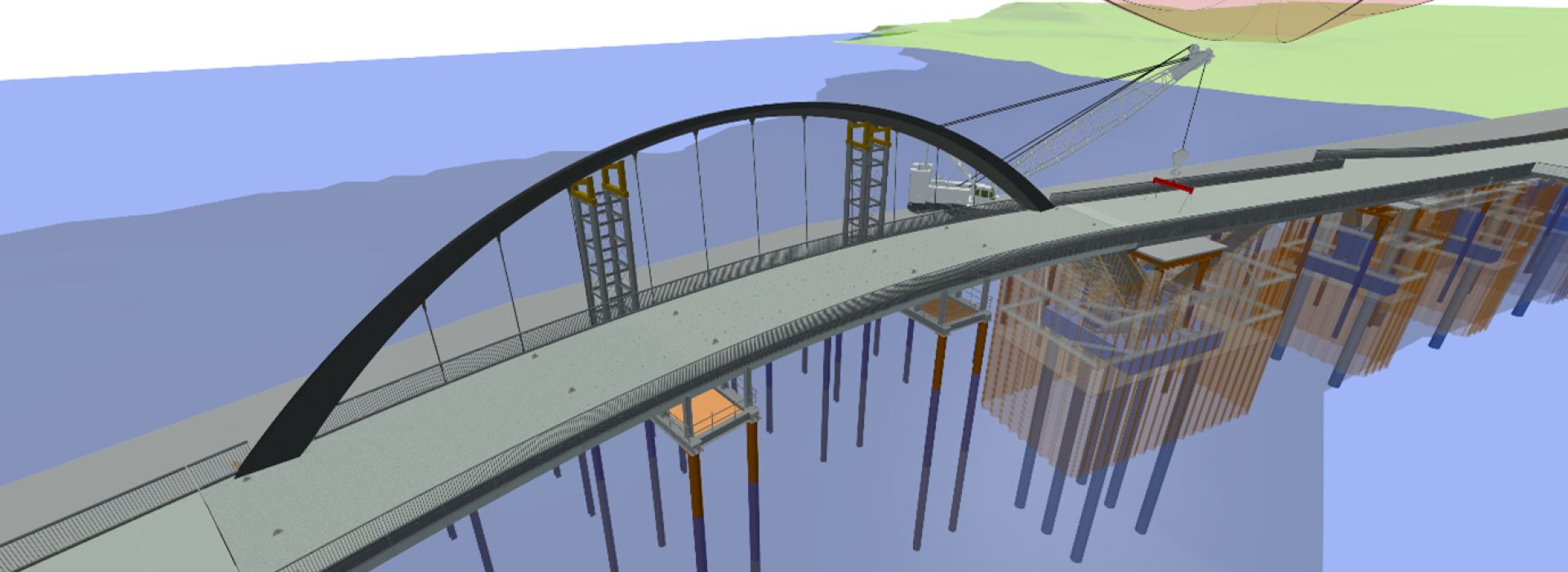
On the Old Māngere Bridge Project in Auckland, our digital engineering team developed a detailed temporary works and construction staging model to test and coordinate all temporary and permanent works interfaces.
This 260 m long pedestrian and cycle bridge traverses a sensitive marine area and under 110kV power lines, presenting several complex construction challenges.
Mobile crane and piling rig movements were tested against the HV power line Minimum Approach Distance (MAD) envelope to ensure the construction methodology could be achieved safely. In a New Zealand first, the HV envelope geometry was referenced by geospatial sensors fitted to the mobile plant, triggering proximity warnings and automatic shut-down if the envelope was breached. This tool is now widely used across New Zealand.
Other elements that were modelled included the adjacent temporary bridge structure and piling platforms; cofferdams at each pier; pier form and falsework; all propping, and temporary support structures for the main deck and steel arch. Fabrication drawings were subsequently developed from the model for the temporary support elements.
Our use of digital engineering on this project contributed significantly to a safe and efficient construction methodology.
Closing Text - General with contacts, no video
Summary
Thank you for taking an interest in McConnell Dowell's skills, capabilities and approach. Additional information is available on our website, including additional project case studies.
Contact us through the link(s) below for advice or assistance with your project.